


By Gabe Valentin, Performance Coach
There is a belief we run into constantly: once you pass a certain age, or have been hurt too many times, training is just not for you.
Too old. Too broken. Too far gone.
That is not how the body works. Here is why that belief does not hold up.
We hear some version of this all the time:
If any of that sounds familiar, you are not alone. But none of it holds up once you look at what happens when someone commits to training the right way.
It responds to what you ask of it. Every time. Give it the right demands, applied consistently, and it adapts. That is not motivation talk. That is how the human body works.
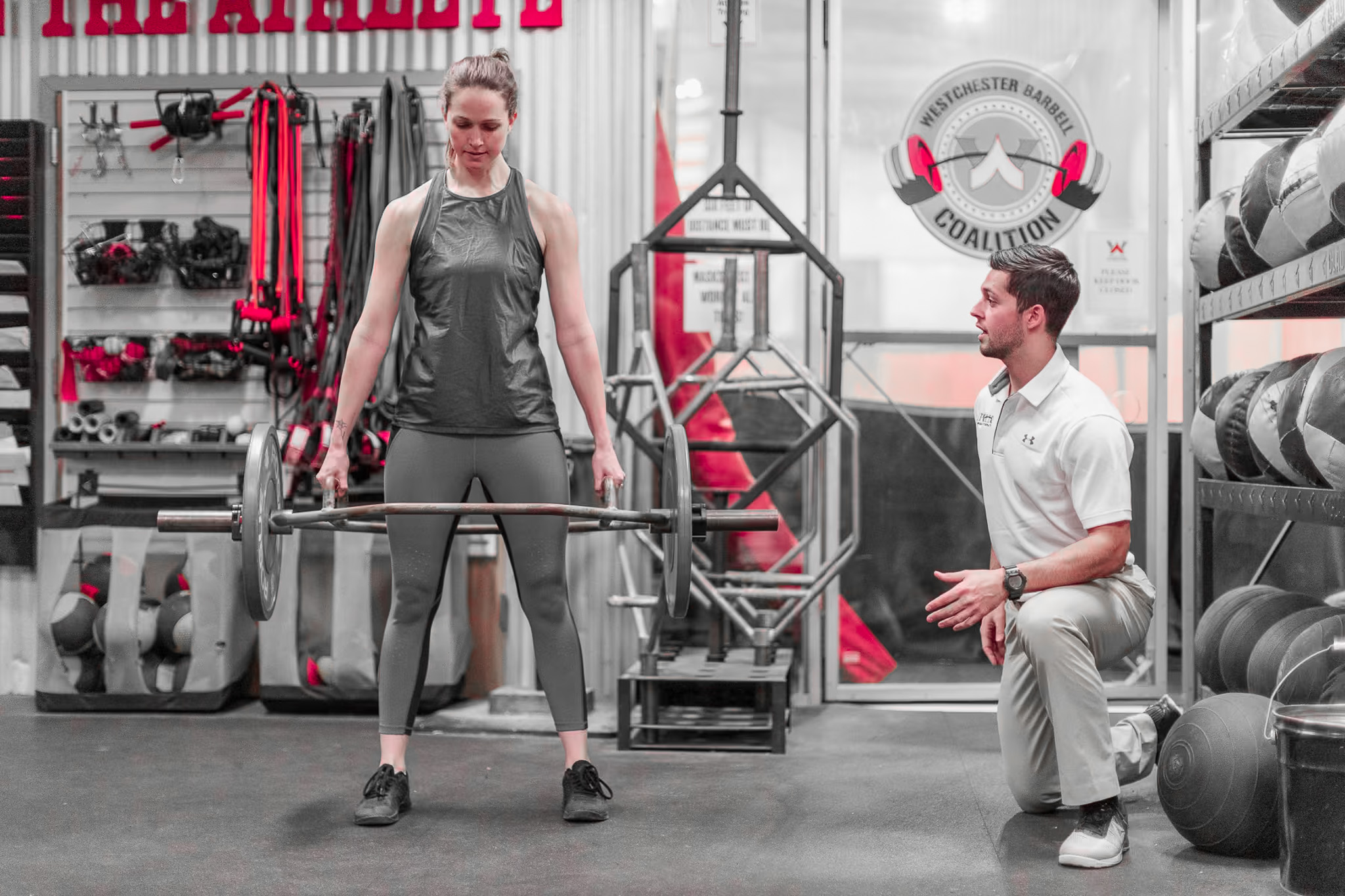
This is where good coaching makes the difference. Not extra intensity or extra volume, just the small things done right: creating tension in the correct spot, understanding proper loading mechanics, and knowing the why behind a drill instead of just going through the motions.
We have watched clients go from feeling like they had given up entirely to signing up for the NYC marathon a year later. That is a real client, not a hypothetical. It did not happen because they found a secret. It happened because they showed up and did the work, consistently, long enough for the adaptation to catch up. That consistency is the whole game, and it is the same shift Brett describes in Why Making Health Part of Your Identity Changes Everything.
A lot of people believe the gym is where injuries happen. In most cases, it is the opposite.
Now, walking in on day one and trying to back squat 300 pounds to impress your friends is a different story. That is how you end up on a gym fail video, and nobody wants that.
But training with intention, built around what you are actually dealing with (a sore shoulder, a tight lower back, achy knees), tends to lower your risk of getting hurt over time, not raise it. The best evidence comes from sport: a 2014 meta-analysis of 25 randomized trials and 26,610 participants found that strength training programs reduced sports injuries to less than a third of the rate seen in comparison groups, the largest effect of any approach tested, while stretching alone showed no benefit.[1] Most of those trials were in athletes and other active, younger people, so treat it as support for the principle, not a promise.
If your injury history is the thing keeping you out of the gym, it is also worth rethinking the idea that you have to wait until nothing hurts. Brett breaks down why that mindset can hold people back in Should Rehab Be Pain Free? The Honest Answer.
Purposeful training also builds muscle size and strength, improves power, and supports your bones. A 2025 meta-analysis of 17 randomized trials in 690 postmenopausal women found resistance training improved bone density at the lumbar spine, femoral neck, and total hip, although the authors describe the results as preliminary and call for more high-quality trials.[2] Brett covers the bone density side in more depth in Why Resistance Training Matters More Than Ever for Aging Women.
These are not abstract fitness terms. They are the qualities that carry over into how you move and feel day to day.
It does not matter if you are 50-plus and have never set foot in a gym. Everyone can benefit from some form of training.
Power is one of the first things we lose as we get older. Muscle power, the ability to produce force quickly, declines earlier and more steeply with age than muscle strength does, and it is an important predictor of functional limitations in older adults.[3] In our experience, reactive ability, how fast you can respond when something goes wrong, tends to fade alongside it.
The good news is that power is trainable at any stage. A 2022 meta-analysis of 15 randomized trials with 583 older adults found that power training improved muscle power more than traditional strength training, with smaller but significant gains on speed-based function tests.[4] That is the quality that lets you catch yourself if you trip, or get a hand out fast enough to stop a fall before it happens. It sounds small until you need it. If you want to know how we build it safely, start with Speed and Power Training for Active Adults.
Your body is not too old, too broken, or too far gone. It is adaptable, if you train it that way.
You do not need to count the years you have left in good health. You can make the years you have count.
As the year winds down, this is usually when people start telling themselves it is a good time to wait until next year. It does not have to be. The best time to start is whenever you decide you are ready, not January 1st.
If you have been putting it off, this is your sign. Come talk to us. We will meet you where you are.
Gabe Valentin is a Performance Coach at Apollo Performance Chiropractic & Training in Pleasantville, NY.


